September 2026 price watch
VPN discounts came and went in September.
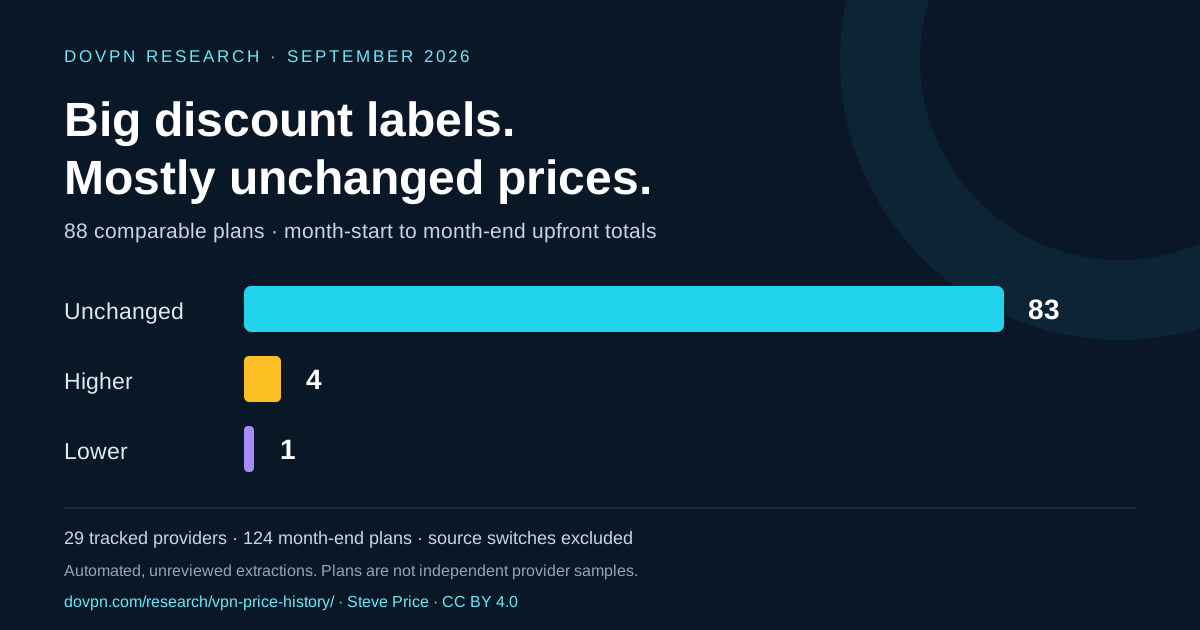
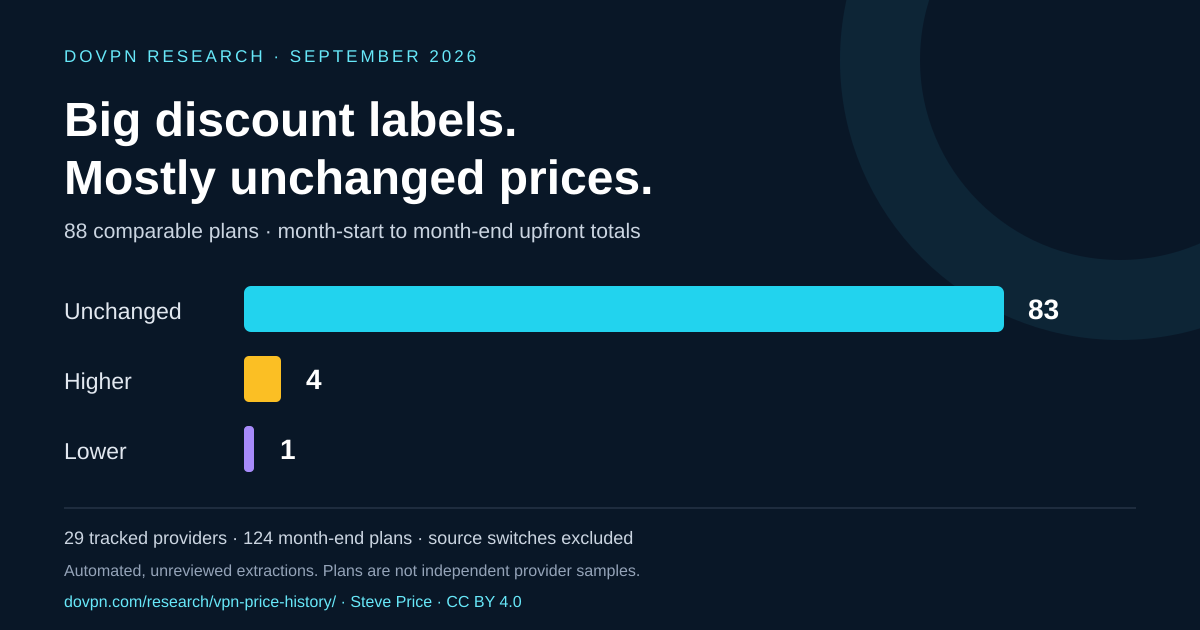
Of 88 plans we could compare from the start to the end of September, 83 had the same upfront price. Four cost more and one cost less. CyberGhost, PIA and ExpressVPN offered lower prices during the month, then returned to their opening amounts.
VPN sale pages make the discount hard to miss. The upfront payment is usually there too, though the renewal bill can take more reading. What the page rarely gives you is a history: was the offer cheaper last week, and has that supposed sale price stayed the same for months?
We started keeping that record. The DoVPN price explorer now covers every plan collected from our 29 tracked providers, including providers we don't feature in our deal comparisons. You can pick a provider, compare its plans and check the lowest and highest prices we've recorded.
The one lower closing price
IPVanish Essential's 24-month offer opened at $59.76 and closed at $57.36. The $2.40 reduction was 4.02%, comparing the same plan and pricing source. It was the only lower closing amount among the 88 comparable plans.
Amnezia Premium's six-month offer rose from $28 to $30, and its annual offer from $48 to $50. TunnelBear's annual offer went from $59.88 to $69.99; its monthly price went from $9.99 to $10.99. Those are four plans from two providers, so counting them as four separate companies would overstate the spread of the increases.
Surfshark One's long-term offer was higher in the first September capture than in the last August capture. It appears in the change log, but its September opening and closing prices match. The dates you choose change the answer.
The remaining 83 comparable plans finished at their opening prices. We kept USD, EUR and GBP separate, and left out the 36 cataloged plans whose endpoints were missing, unusable, newly present or affected by a change of source or billing terms.
The discounts a monthly snapshot would miss
CyberGhost's 26-month offer dropped from $56.94 to $51.74, then went back to $56.94. Anyone checking only the first and last price would see no change. A buyer who caught the lower offer would have paid $5.20 less upfront.
A discount that came and went
CyberGhost · 26 months · upfront total in USD
PIA's 39-month offer followed a similar path: $79, then $69.81, then $79 again. ExpressVPN's Advanced and Pro long-term tiers also fell before returning to their opening amounts. Across the retained plan series, we recorded 14 price movements during September, including reversals.
A capture tells us when we saw a price. It doesn't tell us the exact minute a provider changed it, or how long every visitor could get it. The graph uses the final capture each day; the historical range table and downloads also keep intraday offers. That lets you find a recorded low even when it was gone by the day's final check.
Proton's $12 difference came from another offer page
On September 9, Proton VPN Plus's recorded 24-month total changed from $83.76 to $71.76. Our collection had moved from Proton's standard pricing page to its public partner-offer page. The lower number came from a different sales channel.
We recorded the switch in the source-change ledger and split the price history at that point. The graph leaves a break, and the statistics give the two sources separate rows. We exclude the $12 difference from the price-cut count because we aren't observing the standard offer become cheaper.
The same rule applies to coupons, regional offers, different tiers and extra bonus months. Before comparing two totals, check what each payment buys and which offer page it came from.
Checking the price behind a discount badge
A "70% off" badge may compare a long-term subscription with a monthly tariff or a listed reference total. It doesn't establish that customers previously paid that reference amount for the same subscription. Nor does it tell you how the offer compares with last month's price.
Our history begins in August 2026. It can show that a recorded price stayed flat, fell briefly or rose within that window. It cannot establish selling prices from earlier years, or a provider's intent. The September results do not prove that a company deliberately misled buyers.
The discount fields have their own source labels. Some percentages come directly from the page; others are calculated from a reference total. We keep that distinction in the downloads. If you're checking an offer, start with the payment amount and duration, then use the discount percentage as a claim to examine.
Renewal can cost more over a shorter period
The initial "per month" amount often divides one upfront payment by the whole service period, including bonus months. Renewal can bill for fewer months at a higher total. Comparing just the two invoice amounts misses the difference in duration.
The monthly equivalent changes at renewal
IPVanish Essential · recorded September closing terms · USD
$57.36 upfront for 24
months.
This is the initial payment spread across the service period.
$99.99 per 12
months.
The billing period is shorter than the initial subscription.
The explorer has a separate renewal measure that divides the recorded renewal total by its billing months. The data identifies whether the collector found that figure on a page, at checkout or in a policy. Missing terms stay blank. Policy-derived figures need their source and interpretation checked before anyone treats them as a promise about a future bill.
For a purchase decision, write down the upfront payment, total service months, next billing amount and next billing period. Check the taxes and cancellation terms too. A headline discount won't do that work for you.
Check a plan, or use the data in your reporting
Choose a provider in the price explorer to see all its plans. Separate charts make the tiers easier to read; the overlay puts them on a common scale. Change the date range to see each offer's recorded low, high, latest price and daily median. The range table also shows how far the latest price sits above its low and how many price movements we observed.
The frozen September release contains the complete sanitized history. Each completed month gets a dataset and dated report, while the main explorer advances to the latest accepted release. Older monthly pages keep their original coverage.
For a citation, use Steve Price, the monthly release ID, coverage dates and currency. The methodology explains the extraction checks and comparison rules. Verify the source for the claim you intend to publish. Corrections and supporting evidence can go to steve@dovpn.com or the public repository.
DoVPN earns affiliate revenue on its commercial pages. This analysis has no affiliate purchase links in its body. We did not request provider responses before publication.